
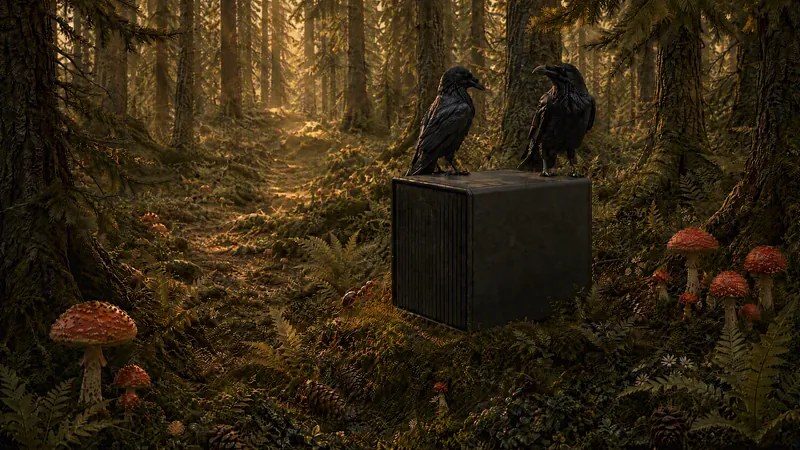

Two black ravens stand out against the red dawn. Observing and listening; nothing passes them by unnoticed. They cut through all of Midgard, the world of humans, and by dusk, return to Valhalla to rest on their master's shoulder, croaking about events seen and news heard. The raven on the right-hand shoulder, Huginn, shares his cunning thoughts. The raven on the left, Muninn, contemplates the past. Two kindred spirits, croaking for attention from the same master.
Every organisation has its own two ravens, though most never hear them. Memory without thought is inconsequential. Reasoning without memory loses meaning. A company that retains everything is a collection of experiences, but missing a sense of what matters. A company that lives on reason alone may solve immediate problems, but never steer a course beyond the present.
That is the role of the master, Odin. The ravens travel, observe, return, and reflect, but Odin decides. Having access to everything that happened, and the means to reason about it, does not tell an organisation what to believe, what to question or what to do.
An AI model can analyse a decision, retrieve precedents and propose alternatives. It cannot take responsibility for the judgment an organisation makes. The priorities, and preferred prejudices about what and who matters in the world, and how to discriminate appropriately (deciding what to do next), come down to the judgment of the master.
In the old Norse poem Grímnismál, Odin confesses that he fears Huginn may not return, but fears even more for Muninn. To lose Memory is to lose oneself. Memory carries something that thought alone cannot recreate: the accumulated experience that makes us who we are.
To lose Memory is to lose oneself.
Organisations are shaped by decisions that worked, by those that failed, and the often unwritten knowledge of why this happened. Lose Memory, and Reasoning must begin anew, forever repeating itself. Technology accelerates each answer, but cannot restore the experience that gave answers their meaning.
Yet Memory, left to its own devices, yields other obstacles. What used to work is assumed to always work. An organisation set on upholding procedures is less able to recognise when the world changes. To learn is to unlearn what no longer holds.
Intelligence, in brief, is to improve one's judgment.
That is the ambition behind private institutional intelligence. A model alone cannot create it, and a repository of documents will not preserve it.
Myrstack provides the private technological foundation for that relationship: compute, models, and applications that can work with an organisation's own knowledge without making external disclosure the default. By maintaining that foundation as technology evolves, we reduce the friction of using AI so organisations can concentrate on questioning, learning and applying what they know. The technology is our responsibility. Intelligence and judgment remain theirs.
When the ravens return, can you hear them both? Can you recognise when experience should guide a decision, and when that experience needs questioning. The ravens may return every evening, but who is listening when they do?